Search This Blog

Saturday, December 10, 2011

NBA Officially in a State of Chaos


For the most part, the basketball community felt a huge sigh of relief when the lockout was lifted.  But did that spell the end of the turmoil among Commissioner David Stern, the players, and the owners?  We should have known better.  We should have predicted that, after months of several heated discussions, that rifts would be permanently created and grudges would be held.  After both sides made considerable compromises to end the lockout, promises were made to both the players and owners that efforts would be made to ensure their needs would be met.  So after all this, what’s the outcome?  For one, every team transaction, from here on out, will be further scrutinized by everyone in the league.  Now, the same day the lockout ended, we’ve already seen how ugly things have become with the chaotic Chris Paul trade fiasco.  In the end, the NBA has seriously tarnished its brand, and things seem to quickly be spiraling out of control. 

Let's hope the league wises up and allows CP3 and Kobe to become teammates

The unfathomable veto of the trade that would have brought Chris Paul to the Lakers is the latest episode in what’s been a devastating blow to the NBA’s image.  Owners were furious that yet another star player would be moving to a premier franchise.  And from my understanding, it wasn’t JUST the acquiring of Chris Paul alone that prompted the owners to react; rumors swirled that the Lakers still had a chance to acquire Dwight Howard from the Magic.  While it may not have been feasible immediately after the Lakers parted with both Pau Gasol and Lamar Odom to get Paul, owners were still weary that Howard might eventually finagle his way to LA – especially if he’s not traded to another team. 

Scola (left) and Gasol (right) would provide offensive
firepower to their respective teams' front lines
What kills me is that this trade was said to be vetoed for "basketball-related" reasons.  Are you kidding me?  From a basketball perspective, it's fair to say that New Orleans may have fared the best of the three teams from doing this trade.  Lamar Odom, Luis Scola, and Emeka Okafor together would have formed a playoff team-quality front court for the Hornets.  That's before even mentioning the acquisition of Kevin Martin and Goran Dragic - who are both up-and-coming prolific scorers (if you don't know Dragic, check out this 23-point 4th quarter outburst he threw down on a very good San Antonio team in the 2010 Western Conference Semis).  From a marketing perspective, you obviously can't replace CP3 - even with these high quality players.  But it baffles me that the league doesn't realize that this is a much better option than letting Paul walk at season's end, and thereby giving New Orleans nothing in return. 

 This isn't a bad trade for the other two involved teams, either.  In the aftermath of losing Yao Ming, Houston would have landed the second-best big man in the league in Pau Gasol - and were already in the running to land Nene.  And of course, Kobe and CP3 would form the best back court in the NBA for the Lakers - albeit with a thin front line.  So how the hell is NOT doing this trade better for all three teams from a basketball perspective? 

Clearly, there are lingering issues resulting from egos of owners and players in the aftermath of the lockout.  So who's at fault for keeping this going?  

By opposing the trade of CP3 to LA, Cavs owner Dan Gilbert is
showing that he's obviously not over the loss of LeBron James
To owners, the new CBA should have further prevented teams from stacking up the league’s best players; ever since LeBron, D-Wade and Bosh joined forces in Miami last offseason, owners became determined to not allow something like that to happen again.  Thus, when the very first news they hear (on the SAME DAY the lockout ends, to boot) is the rumors of CP3 and Dwight Howard both going to the Lakers, their natural reaction is to push back.  They were promised competitive balance, and felt they were lied to.  I think all basketball minds agree that New Orleans, in the proposed trade, got a pretty damn good deal out of it.  But if we’ve learned anything this offseason, it’s that most owners don’t see things from a basketball perspective – only money. 

At the same time, you can’t blame players for wanting to play for bigger market teams.  To CP3, his desire to achieve long-term security (by signing an extension with the Lakers) has been denied.  If he blows out his knee this season, he’s screwed.  There’s no denying he has a right to be livid at the league.  Smaller market teams want more than 1% chance of landing star players to improve their venue, but other than a few exceptions – Reggie Miller with the Pacers, Tim Duncan with the Spurs, and Kevin Durant with the Thunder – star players prefer bigger markets.  That’s never going to change, and owners need to come to terms with that. 

Things will only get uglier from here on out.  We’re being told that this happened ONLY because the NBA currently owns the Hornets, causing a perfect storm for this debauchery to happen.  But hence forth, every blockbuster trade - especially between big and small-market teams – is going to be heavily scrutinized.  Even the New Jersey Nets, who are widely anticipated to be considered a bigger market when they move to Brooklyn next season, got in trouble for tampering in their ongoing attempts to trade for Dwight Howard.  Howard, who is open to the idea of playing with All-Star guard Deron Williams, now has more political obstacles to overcome.

It's not just the NBA-owned Hornets whose trade discussions are under scrutiny;
the growing chaos has hindered trade talks involving Dwight Howard (left) and Brook Lopez (right)

What a mess.

So who is to blame for the NBA’s image spiraling out of control?

The easy scapegoat, of course, is David Stern.  He’s the one who allowed the lockout get to the point where it did.  He’s the one who’s been really wishy-washy on why he vetoed the trade.  He’s the one hiding from all the heavy criticism.  But remember that ultimately, Stern answers to the owners; the only reason he’s employed is because of the owners.  He claims all of his decisions are not affiliated with any pressure he gets from owners, but IMO, that’s not plausible. 

David Stern has long ago worn out his welcome
All things considered, he really needs to retire.  He’s gotta go.  The NBA badly needs new leadership.  Regardless of whether he’s truly at fault, we know Stern’s reputation is now irreparable, and that he shouldn’t linger around any longer trying to salvage it.  Besides, he wouldn’t be the only sports figure failing to go out on a high note; just two months ago, we saw Penn State legend Joe Paterno’s last season marred by the Jerry Sandusky scandal.  But unlike Paterno, Stern’s leadership has been far from flawless up to this point.  In fact, you can question the very beginning of his reign upon the first NBA draft lottery in 1985:  many conspiracies are out there giving solid evidence that Stern “aided” the New York Knicks to win the draft lottery – and of course allowing them to land #1 pick Patrick Ewing.  Of course, the infamous Tim Donaghy scandal comes to mind as well, which put the entire integrity of the game into question.  Fair or not, Stern’s legacy will always be associated with these conspiracies. 

It's tough to imagine either Greg Oden or Brandon Roy
ever setting foot on an NBA court again
The growing rift between the owners and players is not the only sad story to surface before this already-shortened season even started.  Portland Trailblazers star Brandon Roy, who could no longer avoid the inevitable, called it quits on account of his gimpy knees.  We saw flashes of the great player he could have been in Game 4 of last year’s First Round matchup vs. the eventual NBA Champion Dallas Mavericks, and it appears that's the last of him.  Things are also looking pretty glum for his teammate Greg Oden, who is continuing to struggle making his way back on the court after a heavily injury-ridden start to his career.  So on the Blazers front, the already-sad story is only getting sadder. 

Somehow, even after the labor situation resolved itself, the NBA is looking worse and worse.  All we can hope for now is for the chaos to subside, and that things start looking up once the actual basketball gets underway.  Until then, the bleeding won’t stop and the growing divide between players, owners, and the commissioner will not be set aside.

Saturday, November 26, 2011

End of the NBA Lockout = A Huge Exhale


I'm looking forward to seeing action shots on the court -
not pictures of Billy Hunter (left) and David Stern (right).

Many people asked me why I stopped blogging, even with the scary-but-realistic possibility of no 2011-12 NBA season.  They said I could write about the lockout and what I thought about it.  I could’ve written a general synopsis of the labor negotiations.  I could’ve made an assessment on the position of both sides, and whether I sided with the NBA or the Players Union.  I could’ve followed the constant cycle of rumors and constant teases of a possible labor deal, only to learn that the talks broke down.  But I didn’t bother. 

Now that we’ve been given an early Christmas gift with this weekend’s tentative agreement in place, I can finally vent about the lockout and tell you why I’ve been quiet this whole time…


I hated every moment of the lockout.  HATED it.  I hated talking about sh*t that has nothing to do with the game itself.  I hated all the over-analysis of the 150-day long negotiation process.  During a time we were supposed to talk about free agency and everything else in the basketball landscape, we were only hearing news about progress (or lack thereof) being made in negotiations.  I just couldn’t stand the thought of enduring several months with no basketball to watch.  I even tried watching some college basketball recently, as I was resigned to the fact that an NBA season probably wasn’t going to happen.  Couldn’t do it.

Players union President Derek Fisher is one of the few
who knew what really went down behind the scenes.
Fear of loss wasn’t the only thing that kept me from blogging.  In general, I just stay away from forming my own opinion in politics – especially when I’m not involved directly.  In fact, I don’t know if any basketball analysts or bloggers are collective bargaining experts (although they sure tried to act like it).  Did any of us really know what went down during the labor talks?  Not really.  All the reports emphasized the difference in the split of Basketball Related Income (BRI), the salary cap flexibility, and other contractual terms.  However, even when the two sides appeared to be making ground on those contentious issues, it didn’t result in a deal.  So really, we don’t know exactly what the hold-up was. 

But here’s what we know for sure:  neither the owners nor players gained any popularity over this time period.  It is hard for fans to sympathize with billionaires and millionaires arguing about money, and understandably so, given how much was at stake.  It also became evident that there was a growing divide amongst both the players and owners.  Both sides tried to hide that fact in order to maintain their hand, but that’s a near impossible feat in today’s social network-ridden world, where there are too many outlets for everyone to express their opinion.  Even though this has been looked at as the owners vs. players, it became obvious that there was no unity on either side.  We've seen evidence of this from Miami Heat owner Micky Arison, as well as Dallas' DeShawn Stevenson's comments about Billy Hunter.  If the lockout were to go on any longer, things were only going to derail from there.  Paychecks were going to be missed, and 75% of the players that can’t afford to miss games were going to get even more pissed off.  When that happens, it’s best to just take the offer on the table and give the fans what they want before everyone is alienated from the NBA.

If all goes as planned, things will start to get interesting on December 9th, the targeted start date of training camp.  We still haven’t had free agency, and that could very well change the landscape of the season.  Also, will there indeed be an All-Star Game in Orlando in mid-February?  Are we having 3 ½ months of a jam-packed 66-game schedule, or are games going to get pushed out resulting in late-June playoff games?  There are still a lot of questions to be answered, but at least they’re basketball-related questions.  

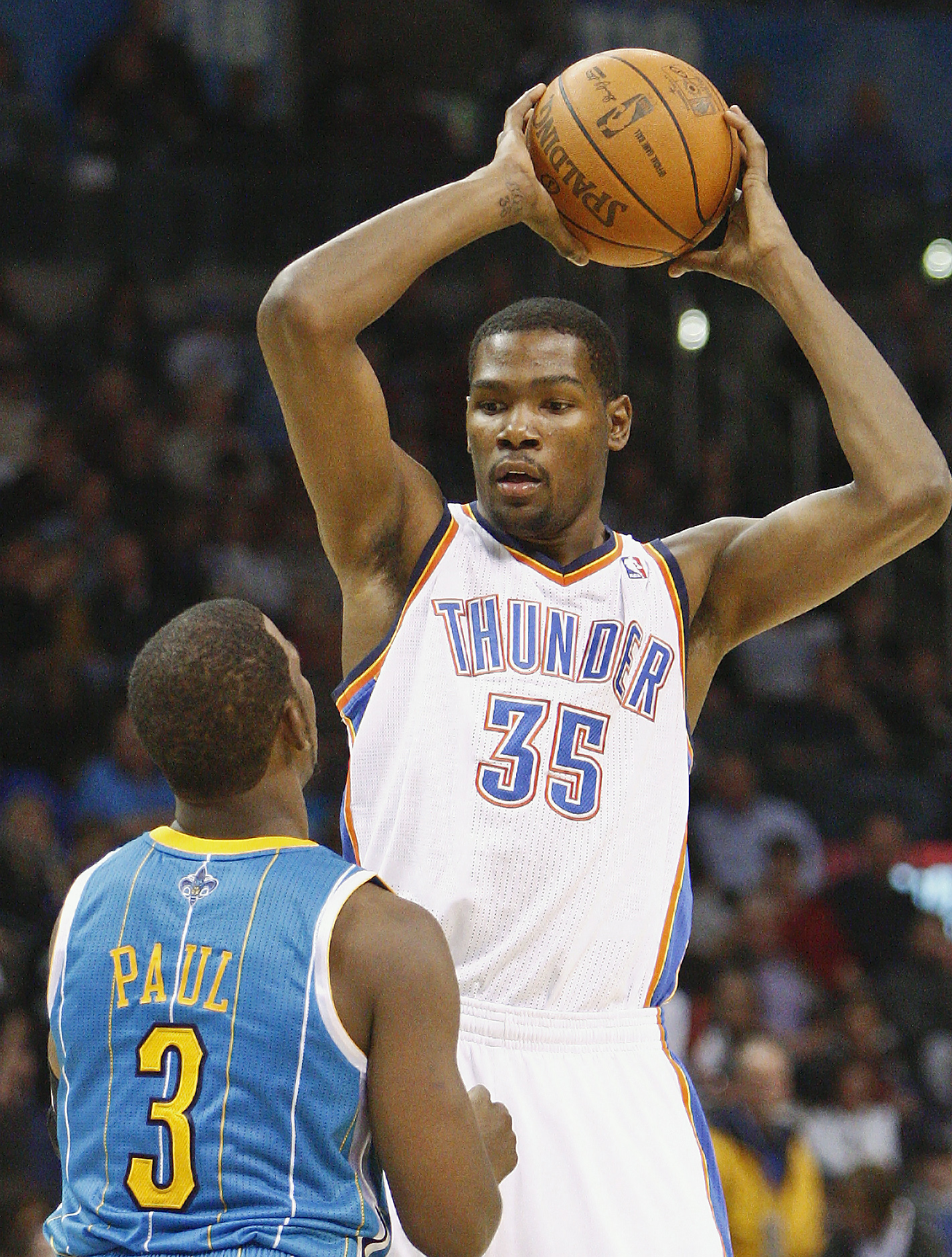
From now on, it will be tougher for guys like Chris Paul
and Kevin Durant to team up under the current CBA.
Now, how is the new CBA going to affect the landscape of the NBA?   From looking at the terms of the deal at first glance, a harsher luxury tax will be put into effect for teams that are over the salary cap.  Although there is no hard cap, this may somewhat discourage teams like the Lakers and Knicks to reach into their deep pockets.  Therefore, the new deal will stimulate competitive balance amongst all 30 teams to a degree.  Hopefully, we will no longer see a ridiculously one-sided trade as ludicrous as the infamous Pau Gasol trade from Memphis to LA in exchange for the Lakers’ benchwarmers.  At the same time, you’ll never see a team pull off what Miami did last offseason in acquiring their Big Three.  In the long run, I think this is good for the league. 

On the other hand, the rules in place that will permit competitive balance will come with a caveat: this labor deal may give birth to the amnesty clause, where teams are permitted to release a player without incurring further luxury tax on the player’s contract no matter how lucrative it may be – an essential repeat of the 2005 “Allan Houston rule.”  This time around, in addition to the luxury tax relief, there will be a small cap relief to boot; 75% of the player’s contract value will be taken off the team’s payroll.  The rule this year will most likely be named after Washington’s Rashard Lewis, who is still owed $27.7 million.  Essentially, this rule gives forgiveness to teams that gave out such regrettable deals (or traded for them).  So, while the new labor deal will create competitive balance down the line, you may not see the effects of it immediately; teams with high payrolls will be able to shed a significant amount of salary this year, somewhat offsetting the initial blow of the new luxury tax thresholds and restrictions.

It’s obvious who the true beneficiaries are with regard to the end of the lockout.  Players and owners will now start making money, fans will get to watch games and create fantasy teams again.  More importantly, much of the country’s working class – arena workers, etc. whose income depends on games being played – now have jobs again. 

Maybe I’m just biased since I live here, but I don’t know if anybody’s happier about this than the city of Orlando.   First and foremost, Magic fans will get to see Dwight Howard wearing blue and white for another season (which, quite frankly, may be his last).  Also, the city will get to host the All-Star Game after all.  I, for one, am psyched about it; I’ve never been able to attend All-Star Weekend festivities, and this may be my best chance to do so. Furthermore, the city put so much money into the amazing new arena, banking on both this year’s regular season games and All-Star Weekend venue to help pay off the investment and stimulate the economy.  Now, the possibility of bankruptcy has subsided. 

The Amway Center will now be fully utilized, thanks to the end of the NBA lockout.

I hated every moment of the lockout.  HATED it.  But now, we get to talk about basketball again.  Now, instead of seeing SportsCenter clips of David Stern talking to Billy Hunter, we'll be talking about Derrick Rose and the Bulls taking on Kobe and the Lakers on December 25th.  Merry ****ing Christmas!

Friday, June 17, 2011

Cavs Season Wrap and Outlook


Cavs Looking Back:

How they did in 2010-2011: Terrible, as expected after Lebron left. They traded most of their weighty contracts for picks or cap relief picking up one monster in return (Baron Davis). The Cavs picked up castoffs and D-Leaguers to fill out the roster. They somehow lost a record 26 games in a row as the pathetic yet interesting highlight of the year. Managed to play .500 ball the last 12 games to hand Minnesota the worst record. By another miracle they won the draft lottery.

With a roster full of virtual no-name players, the Cavs
came out on top...of the lottery standings

Cavs looking forward:

The Cavs would obviously love to somehow land both
Kyle Irving and Derrick Williams

Draft:
They currently have the #1, #4, and #32 picks. The #1 will go to Kyrie Irving. Irving is an elite college PG and they sorely need someone like that after years of Mo Williams and Lebron running the point. Pick #4 is the bigger decision for the Cavs management. Do they stick with #4 and go big euro (Kanter/Valanciunas/Vesly) or do they trade up to get Derrick Williams? They need to pick a guy with sure talent and develop him the next 2-3 years. Trading up doesn’t change that fact so my hope is they stay pat. John Krolik brings up a great point that the Cavs will be picking #28-40 many times in the next 5 years (thanks Miami). These guys need to be solid rotation or project guys. This plan also tells me the Cavs won’t try to contend immediately.


Roster: Salary-wise things look good. Only Chris Eyenga and Andy Varejao have contracts longer than 2 years headed into the 2011-12 season. Antawn Jamison and Baron Davis can be traded easily now that their contracts are expiring or soon-to-be expiring. Both have something left in the tank and a contender might want to take them on to shore up their bench or fill in for an injured starter. JJ Hickson becomes an interesting trade piece if they draft a big man. After that things don’t look so good. I would count Varejao and Eyenga as the only pieces the Cavs have for the future. If Eyenga develops over the next 2 years that helps but look for him to be participating in dunk contests and coming off the bench for athleticism. If you’ve read my Draft synopsis then you know the Cavs plan is to build a contender slowly over 3-5 years. They could throw in a smart trade here or there but don’t count on them trying to put together a Big 3 (or any FAs even wanting to come to Cleveland for that purpose).

One of the few brights spots of the 10-11
season, JJ Hickson has developed nicely
Coaching and Ownership: I’m sure any coach could have put together a 19-63 season but Byron Scott was brought in to teach. He seemed to help with the younger players over the course of the season. That is possibly why Mike Brown was let go. His defensive game plan would have probably helped the Cavs record into the 30s but the younger guys would have not become any better (i.e. Hickson in 2010 playoffs). I see him coaching the Cavs until they reach the fringe of contending for a title and then he will probably be let go as he was with all his other teams.


Dan Gilbert is a smart man even if the media gives him hell for his tweets, emails, and letters. All his blather is for the fans and media. It seems to work as Quicken Loans had a decent year in attendance (probably just as good as Miami pre-playoffs). But from the moves the front office has made, it looks like they know the best plan for the Cavs is a long term draft and develop scheme. Bonus: His prognosis about a Cavs championship before Lebron holds true for another year.

Outlook for 2011-2012: The Cavs win more games but barely threaten the 8th seed. I could see them winning handfuls in the beginning and end of the season when teams are off guard, resting, or in lottery mode. Prediction of 31-51.

Wednesday, June 15, 2011

Coming soon: Team Recaps, Outlooks

Just so you know, I plan on spending the boring NBA-less summer looking at each team's 2010-11 season and what to look forward to this offseason as well as next year.  In that, I will include my reaction to the too-corny-to-be-a-movie-but-that's-how-great-it-was NBA Finals in the Mavs and Heat assessments.

Also, since I realized how hard it was to maintain a blog alone, I am adding my friend Dave as a contributing author.  He's one of the very few Cavs fans left that I know, so his insight will be valuable.

Sunday, June 5, 2011

The Legacy of Shaquille O’Neal


Shaq.  The Diesel.  The Big Daddy.  Superman.  The Big Shamrock.  Shaqtus.  The Big Aristotle.  The list goes on and on.  Now, he’s going to be the Big 401k. 

Shaq may have been the greatest at
 winning while entertaining in sports history

Only a legend would be able to acquire all these nicknames.  Perhaps the most prominent celebrity figure in the history of the game, Shaquille O’Neal is finally hanging up his sneakers.  As a huge fan of basketball in general, I wouldn’t be doing this blog justice by not trying to take a look back at his illustrious career.  As NBA commissioner David Stern says, he really is a true giant – both on and off the court.  He has established his legacy as both an entertainer and a Hall of Fame basketball player.  If you can get perspective on everything he’s accomplished, you’ll realize he truly is larger than life. 

What can you say about his basketball career?  He became a dominant force once he got to the NBA in 1992.  A 15-time All-Star, 4-time champion, 3-time Finals MVP (and somehow only a 1-time regular season MVP); his accomplishments make him rank him up there among the greatest big men ever to play the game.  His tremendous impact on the game was evident once he set foot on the court. In his rookie year, he played a game against Boston and was matched up with Kevin McHale and Robert Parish when they were still on board.  Stunned by the one-of-a-kind physical specimen that anybody has ever encountered before, McHale said he and Parish looked at each other during that game and both said “Yeah, it’s about time to retire!” 

More than any other basketball legend (except maybe Charles Barkley), Shaq was equally well-known for his hilarious demeanor and publicity stunts as much as for his basketball achievements.   Because of the attention he’s drawn to himself from the fans, media, and players, he has called himself “very quotatious” as a result.  One of my favorite Shaq quotes of all time happened when the NBA conducted a BMI study during the 2005-06 season and Shaq was asked about his high BMI (which was well in the obese category); his response:  “Top 50.  Three Rings.  Lotta Money.  Two Mansions.”  Of course, he has four rings now, and he goes down as the most dominant player the league has ever seen. 

Even if you rooted against Shaq, you had to
love his ability to entertain in other ways
For anyone who didn’t like his game (truth be told – for a long while, I was among this group), you had to love the guy off the court.  If you ask anyone that’s spent time with him, he is an absolute blast to hang out with.  Not only did he embrace the social media to cultivate his image with fans and the press, but he was very active (and interactive) with the community.  Very few famous people embrace being a celebrity the way Shaq does; he knew better than anybody that athletes are supposed to be entertainers as well.  Whether he's break-dancing, pretending to be a point guard, kissing Tracy McGrady, or intentionally throwing free throws off the backboard to do monster (but illegal) put-back dunks at All-Star games, he never ran out of ideas for giving everyone a good laugh. 

Since I’ve never met him personally, I’m only basing this off of general observation and the perspective of others:  he is one of the most approachable celebrities you’ll ever meet.  Most stars and icons are low-key and want to be left alone; they usually have bodyguards with them in public to ensure people don’t harass them.  Not that there’s nothing wrong with that, but Shaq never did mind being out in the open for anyone to come up close to him.  Of course, at 7’1” and 350 pounds, he’s not exactly someone who needs to fear for his security.  Still, if you see Shaq at say, a restaurant, he would come over to your table and grab something from your plate. He'd make sure you weren't shy about coming up to him to say hi.  Even though he was a true beast, he was gentle and friendly in nature.  

He also pulls a lot of publicity stunts, like his “Shaqtue” act –  where he sat silently at Harvard Square and let everyone there take pictures with him.  With the era of social networking blossoming, he is a very active “Tweeter,” always sending out public message videos and gives fans a chance to interact with him.   

With so much that went on during his storied 19-year career, I could go on and on about his memorable moments.  Instead, I’ll go through some of the common questions and misconceptions about his legacy:

Misconceptions

“Was Shaq really that good?  He only won because he was bigger than everybody.”  

When motivated, Shaq was a devastating force
that could not be stopped
This is the most common misconception among casual sports fans with regard to Shaq – that he was only good because of his size and strength.  While those were his two greatest physical assets, everyone must understand that he had many, many more skills than just his behemoth presence.  First and foremost, his mobility was absolutely remarkable for a guy his size.  Over the course of his career, he greatly improved his passing ability, especially out of double and triple teams.  his most dominant years were as a Laker from 2000-2004.  In fact, to get a true understanding of how skillful he actually is, compare him with Dwight Howard.  The two of them are very similar.  In fact, Dwight is actually more athletic than Shaq ever was.   But many of Dwight’s criticisms – lack of offensive moves, inability to hit free throws, etc. – were weakne