Search This Blog

Showing posts with label Derek Fisher. Show all posts

Wednesday, May 23, 2012

LA Lakers 2011-12 Season Recap: Who's to blame?


NOTE:  This article will be published on Fansided's Saving the Skyhook blog, where I am currently contributing as a staff writer.

For the 2nd straight year, the Los Angeles Lakers fell short in the Western Conference Semifinals.  And also for the 2nd straight year, the vast majority of fans and the media have labeled it as a disappointing season.  Out of all the teams going fishing so far, I’ve never heard so many names being thrown around as possible scapegoats than the Lakers.  People think they know who to blame (for the most part, Pau Gasol), but they don’t seem to fully understand how much adversity has affected this team’s chances of contending for a title.

All things considered, the Lakers have overachieved this season.  Since the offseason, there was a series of team chemistry-crushing events that make me wonder why anybody expected them to win a championship.  First, their offseason turmoil last summer was overshadowed by that of the Orlando Magic with the Dwight Howard debacle.  After being swept by Dallas in last year’s playoffs, the Lakers did almost nothing to improve their team.  In fact, they took about five steps back over the course of the season.  Considering their lack of chemistry with this particular roster and style of play, current or incoming players that did not meet expectations, or uncertainty with the roster as well as coaching staff and general disarray, the Lakers should consider themselves lucky for getting this far. 

That being said, let’s break down the top three reasons why the Lakers fell short this year.

1. Instability of the team caused by the front office and coaching staff
The quality of roster management of this team has been shaky at best, and the trade rumors didn’t help matters there.  Star bigs Pau Gasol and Andrew Bynum dealt were involved in trade rumors virtually all season.  In fact, Gasol was almost shipped as part of the Chris Paul trade that David Stern eventually nixed – something that many seem to think would have made them serious title contenders had Stern not rejected it.  Since last season, Bynum has been in trade rumors involving Dwight Howard.  Clearly, the trades made (as well as the trade talk) affected the chemistry of the team.  Even when Kobe Bryant pleaded to GM Mitch Kupchak to make up his mind on the trade rumors – particularly with Gasol – in an attempt to establish some stability for the team, Kupchak and the Laker management continued to keep the team in a state of limbo.  Even Derek Fisher – a staple of the Lakers’ success over the years and one of Kobe’s best friends – was sent packing.

Kobe Bryant wasn't - and still isn't - sure how long
either Gasol or Bynum would be his teammates

A lack of cohesion can be blamed on the coaching staff, as well.  On several segments of the ESPN/ABC studio show, I heard Magic Johnson make several critical comments about Mike Brown and his inability to make in-game adjustments.  He emphasized the fact that this has hindered Brown’s playoff success in years past with Cleveland, as well.  While I don’t disagree with that, people do need to understand how different his system is than that of his predecessor, Phil Jackson.  The Lakers got very accustomed to Jackson’s triangle offense, and Kobe and Gasol absolutely flourished in that system that helped them get to three NBA Finals (and winning two of them).  Talk about big shoes to fill. Adjusting to a new system takes time.  But at the same time, Brown had to realize that he did not have the personnel to run his pick-and-roll and pick-and-pop schemes.  Bynum and Gasol were vastly underutilized throughout the season, despite the two of them being a matchup advantage for the Lakers on a nightly basis.

2.  Pau Gasol got fed up
Short term memory? Just remember how
valuable Gasol was to LA's 09 and 10 titles
As I mentioned, there has been a lot of misplaced finger pointing going on.  One of the biggest scapegoats, of course, is Pau Gasol.  Now, because of how badly people underestimate Gasol’s impact as a Laker, allow me to take the time to defend him.  Since STEALING him from Memphis in 2009 (which was quite possibly the most lopsided and shadiest trade in NBA history), the Lakers have had a 70%+ winning percentage with Gasol.  In their two championship runs in 2009 and 2010, he outplayed many of the league’s premier power forwards and centers in crucial playoff games (Amare Stoudemire, Kevin Garnett, Carlos Boozer, Dwight Howard, and Nene to name a few), even after being universally labeled “soft” in his first season as a Laker in 2007-08.  He became arguably the best two-way big man in the league, and is one of the few top talents that don’t mind playing with Kobe (at least until now).   Being in the shadow of Kobe, his impact has been vastly underrated, and is one of the most underrated true team players on a championship team that I can remember.

That being said, Gasol obviously had a subpar and inconsistent year.  But before you go on blaming him, there are many reasons why Gasol’s play has suffered this season.  First and foremost is the coaching situation, as described above.  He thrives in the post – not running pick-and-roll offenses 20+ feet from the basket.  The second major factor why Gasol is so jaded was the aforementioned nixed trade for CP3.  You saw how Lamar Odom, who was in the same trade, reacted – he was distraught to the point where LA had to dump him to Dallas for basically nothing.  Gasol, on the other hand, maintained his professionalism throughout the season, despite continuing to be in trade rumors and being called out by fans (and sometimes his teammates…and by his teammates, I mean Kobe – more on that below).  When the trade for CP3 got nixed, I thought it was a blessing in disguise, as the Lakers front court depth would have suffered severely without him.  In the end, why he constantly seems get blame and a lack of appreciation is beyond me. 

After a few successful seasons together, you have to wonder
 if  Pau and Kobe's relationship has now deteroirated 
Let’s go back to Kobe for a second.  We all admire his drive and competitiveness, and the fact that he’s almost 34 and is still arguably somehow one of the top 5 players in the league (I was talking to a coworker, a Laker fan, about this:  he’s only a year younger than KG and is the same age as Jermaine O’Neal – yet we consider the latter two to be much, much older).  But this season, not unlike other seasons, he has made several team-dividing comments. When Kobe publicly criticized Gasol for his play in Game 4, TNT’s Charles Barkley couldn’t help but say that Kobe should have been the one to blame for his atrocious shot selection; the Lakers were up handily in that game, and Kobe went away from throwing the ball into Gasol and Bynum and instead took several contested long jumpers.  In the waning moments of Game 5, even with the game out of hand, Kobe was expressing a constant visible frustration toward Gasol on several plays where it appeared the two were not on the same page.  Let’s not forget that this is not the last time he has called out his teammates and refused to shoulder any blame – I will never forget when he completely quit on his team in two very important games:  Game 7 vs. Phoenix in the first round of the 2006 playoffs, and Game 6 of the 2008 NBA Finals vs. Boston.  As much praise as Kobe gets for his freakish durability, high level of play and intense competitiveness, instances like these can help one understand why many players don’t like playing with him.  I think he’s been extremely overcritical of Gasol, and I don’t think Gasol wants to play another possession with Kobe.

Because of these issues Gasol has had this season with both the front office and Kobe, I think he’s gone this offseason.  He’s sick of being in trade rumors, and he’s sick of being called out and blamed.  And when he does get traded, hopefully he will be in a system more conducive to his strengths.  Maybe then he will get the recognition as an elite player that he deserves. 

3.  The supporting cast was terrible
The issues went deeper than just the star players.  The Lakers’ supporting cast was among the worst of the league over the season (their bench was DEAD last in scoring this season).  Ron Artest, Steve Blake, Ramon Sessions, and Matt Barnes proved not to be effective enough to put the Lakers over the top.  Changes to the roster over the course of the season proved not to be very constructive, either.  Two vital pieces to their 09 and 10 championship runs – Lamar Odom and Derek Fisher – were no longer there.  When they acquired Ramon Sessions from Cleveland, I was suspicious that he would provide the same impact as Derek Fisher.  Early on, he seemed to be on track to proving me wrong (12.7 points, 6.2 assists, and 3.2 rebounds in 30.5 mins per game as a Laker).  But after a horrible postseason (9.7 points, 3.6 assists, and 3.0 rebounds a game), the Lakers have to wonder if they should have got rid of Fisher, who is now in a position to win a title NOT in a Laker uniform. 

Kobe had to get accustomed to playing without two of his best
role players in Lamar Odom (left) and Derek Fisher (right)

Before the playoffs even started, Artest didn’t help matters after earning a seven-game suspension for elbowing James Harden into a concussion.  His absence made the Lakers already-thin bench even worse, and was a big reason why LA even struggled closing out Denver in the first round.  In my opinion, they were very fortunate to even advance past them; if Blake didn’t catch fire in Game 7, the Lakers could have gone home much earlier.  Other than Jordan Hill, the Laker role players were a disappointment.

What should the Lakers do?
With Kobe making $30 million next year, there is not much that LA can do in free agency.  Their best move would be to throw Bynum and whoever else Orlando wants (other than Kobe) for Dwight Howard.  But then, you would have to look at the coaching situation.  If LA gets Howard, is Mike Brown the right coach for them?  He failed to find ways to get two of the league’s best post players to get consistent touches.  Howard had issues with his Orlando teammates for not getting the ball enough; how do you think he will like Brown’s offensive schemes? 

Some have gone as far as to say the Lakers should consider amnesty’ing Kobe.  As much as I blame him for having an adverse psychological affect on his teammates, I still think waiving him is an extreme.  Of all players on the team, he is the one lock to remain in a Laker uniform.
I know this is never gonna happen, but LA and Orlando should make the first ever head coach trade.  I honestly think both teams would be better off.

Summary
Ultimately, the Lakers’ failures have been a result of a lack of chemistry – from the front office to the coaches, and to the players as well.  The fact that they were a few breaks away from possibly being in a position to make the Conference Finals is nothing short of amazing.  I expect a major overhaul over the offseason, with Kobe being the lone guaranteed Laker next season.

Saturday, November 26, 2011

End of the NBA Lockout = A Huge Exhale


I'm looking forward to seeing action shots on the court -
not pictures of Billy Hunter (left) and David Stern (right).

Many people asked me why I stopped blogging, even with the scary-but-realistic possibility of no 2011-12 NBA season.  They said I could write about the lockout and what I thought about it.  I could’ve written a general synopsis of the labor negotiations.  I could’ve made an assessment on the position of both sides, and whether I sided with the NBA or the Players Union.  I could’ve followed the constant cycle of rumors and constant teases of a possible labor deal, only to learn that the talks broke down.  But I didn’t bother. 

Now that we’ve been given an early Christmas gift with this weekend’s tentative agreement in place, I can finally vent about the lockout and tell you why I’ve been quiet this whole time…


I hated every moment of the lockout.  HATED it.  I hated talking about sh*t that has nothing to do with the game itself.  I hated all the over-analysis of the 150-day long negotiation process.  During a time we were supposed to talk about free agency and everything else in the basketball landscape, we were only hearing news about progress (or lack thereof) being made in negotiations.  I just couldn’t stand the thought of enduring several months with no basketball to watch.  I even tried watching some college basketball recently, as I was resigned to the fact that an NBA season probably wasn’t going to happen.  Couldn’t do it.

Players union President Derek Fisher is one of the few
who knew what really went down behind the scenes.
Fear of loss wasn’t the only thing that kept me from blogging.  In general, I just stay away from forming my own opinion in politics – especially when I’m not involved directly.  In fact, I don’t know if any basketball analysts or bloggers are collective bargaining experts (although they sure tried to act like it).  Did any of us really know what went down during the labor talks?  Not really.  All the reports emphasized the difference in the split of Basketball Related Income (BRI), the salary cap flexibility, and other contractual terms.  However, even when the two sides appeared to be making ground on those contentious issues, it didn’t result in a deal.  So really, we don’t know exactly what the hold-up was. 

But here’s what we know for sure:  neither the owners nor players gained any popularity over this time period.  It is hard for fans to sympathize with billionaires and millionaires arguing about money, and understandably so, given how much was at stake.  It also became evident that there was a growing divide amongst both the players and owners.  Both sides tried to hide that fact in order to maintain their hand, but that’s a near impossible feat in today’s social network-ridden world, where there are too many outlets for everyone to express their opinion.  Even though this has been looked at as the owners vs. players, it became obvious that there was no unity on either side.  We've seen evidence of this from Miami Heat owner Micky Arison, as well as Dallas' DeShawn Stevenson's comments about Billy Hunter.  If the lockout were to go on any longer, things were only going to derail from there.  Paychecks were going to be missed, and 75% of the players that can’t afford to miss games were going to get even more pissed off.  When that happens, it’s best to just take the offer on the table and give the fans what they want before everyone is alienated from the NBA.

If all goes as planned, things will start to get interesting on December 9th, the targeted start date of training camp.  We still haven’t had free agency, and that could very well change the landscape of the season.  Also, will there indeed be an All-Star Game in Orlando in mid-February?  Are we having 3 ½ months of a jam-packed 66-game schedule, or are games going to get pushed out resulting in late-June playoff games?  There are still a lot of questions to be answered, but at least they’re basketball-related questions.  

From now on, it will be tougher for guys like Chris Paul
and Kevin Durant to team up under the current CBA.
Now, how is the new CBA going to affect the landscape of the NBA?   From looking at the terms of the deal at first glance, a harsher luxury tax will be put into effect for teams that are over the salary cap.  Although there is no hard cap, this may somewhat discourage teams like the Lakers and Knicks to reach into their deep pockets.  Therefore, the new deal will stimulate competitive balance amongst all 30 teams to a degree.  Hopefully, we will no longer see a ridiculously one-sided trade as ludicrous as the infamous Pau Gasol trade from Memphis to LA in exchange for the Lakers’ benchwarmers.  At the same time, you’ll never see a team pull off what Miami did last offseason in acquiring their Big Three.  In the long run, I think this is good for the league. 

On the other hand, the rules in place that will permit competitive balance will come with a caveat: this labor deal may give birth to the amnesty clause, where teams are permitted to release a player without incurring further luxury tax on the player’s contract no matter how lucrative it may be – an essential repeat of the 2005 “Allan Houston rule.”  This time around, in addition to the luxury tax relief, there will be a small cap relief to boot; 75% of the player’s contract value will be taken off the team’s payroll.  The rule this year will most likely be named after Washington’s Rashard Lewis, who is still owed $27.7 million.  Essentially, this rule gives forgiveness to teams that gave out such regrettable deals (or traded for them).  So, while the new labor deal will create competitive balance down the line, you may not see the effects of it immediately; teams with high payrolls will be able to shed a significant amount of salary this year, somewhat offsetting the initial blow of the new luxury tax thresholds and restrictions.

It’s obvious who the true beneficiaries are with regard to the end of the lockout.  Players and owners will now start making money, fans will get to watch games and create fantasy teams again.  More importantly, much of the country’s working class – arena workers, etc. whose income depends on games being played – now have jobs again. 

Maybe I’m just biased since I live here, but I don’t know if anybody’s happier about this than the city of Orlando.   First and foremost, Magic fans will get to see Dwight Howard wearing blue and white for another season (which, quite frankly, may be his last).  Also, the city will get to host the All-Star Game after all.  I, for one, am psyched about it; I’ve never been able to attend All-Star Weekend festivities, and this may be my best chance to do so. Furthermore, the city put so much money into the amazing new arena, banking on both this year’s regular season games and All-Star Weekend venue to help pay off the investment and stimulate the economy.  Now, the possibility of bankruptcy has subsided. 

The Amway Center will now be fully utilized, thanks to the end of the NBA lockout.

I hated every moment of the lockout.  HATED it.  But now, we get to talk about basketball again.  Now, instead of seeing SportsCenter clips of David Stern talking to Billy Hunter, we'll be talking about Derrick Rose and the Bulls taking on Kobe and the Lakers on December 25th.  Merry ****ing Christmas!

Monday, February 28, 2011

Best Defenders of the NBA

You could describe yesterday’s Thunder-Lakers and Heat-Knicks games with one word:  defense.  Despite all four of those teams being known for their offensive firepower, these games were really about a terrific display of defense.  As any coach will tell you, close games come down to defensive stops.  In the case of these two games, the Lakers and Knicks were able to come up with stops, and the Thunder and Heat were not.

In the final possessions of the Thunder-Lakers game, LA made three crucial defensive stops: Gasol took a charge on Westbrook’s drive, Ron Artest deflected a pass intended for Kevin Durant that led to a steal, and of course LA contested the desperation 3’s in the last five seconds by KD and James Harden to perfection.  On the other end, OKC’s Thabo Sefolosha played tremendous defense (as usual) on Kobe all night, but was unable to stop Kobe’s dagger fade-away in the closing minutes. 

In the Heat-Knicks game, LeBron James was seemingly scoring at will against the Knicks defense.  But in the closing minutes, he failed to convert on a driving layup – thanks to Amare Stoudemire making a great block coming from the weak side (yes, I complimented Amare’s defense – but he deserves credit for this one time) – and he missed a potential game-tying three pointer in the closing seconds thanks to Carmelo Anthony’s contest (and LeBron’s inability to hit clutch jump shots, as I’ve pointed out earlier).   On the other end, Chauncey Billups made some clutch plays, including draining a serious long-ball from about 33 feet after catching D-Wade off guard - tricking him by picking up his dribble and looking to pass to a teammate.  I bet Knicks fans don’t miss Raymond Felton anymore after the last few games since the trade. 

Carmelo Anthony
Melo was locked in defensively vs. LeBron
Great offense beats great defense, but that is what makes making defensive stops that much more challenging.  As Charles Barkley says, there are two sides of the court, and you need to judge teams and players at both of those ends.  If there was only one side of the court, the Mike D’Antoni era of the Phoenix Suns would have been a dynasty.  But that’s what leads to the saying of the clichĂ© that everybody in the basketball world has come to learn:  Defense Wins Championships.

There are several ways a player can help his team on the defensive end of the court.  Perimeter players can play great one-on-one defense and contest shots as best they can.  They can also be active on the passing lanes and create easy offense and transition plays.  Big guys can either play great post defense one-on-one, or they can anchor the paint and help on opponents that drive to the rim.  All of these examples of contributions are critical to team success.  In other words, there’s a reason why guys like Sefolosha, Anderson Varejao, Ben Wallace and Jason Collins are in the NBA; they all are extremely skilled defensive players and are very valuable to any team, despite their limited offensive abilities.  Since there are so many different types of effective defense, it doesn’t make sense to crown one person as the league’s best overall defender.  Instead, you look at several categories and aspects and see who excels in those areas.  Keeping this in mind, I will break down the league’s best defenders in some of the major areas for both perimeter and post players.

First, let’s go through categories of perimeter defense..

PERIMETER DEFENSE

1.       Most Pesky Perimeter Defender – also known as the best “Edward Scissorhands” (aka the Bruce Bowen award) player who uses quick and disrupting hands the most effectively when guarding the NBA’s prolific perimeter scorers.
2.       Best “Post” Perimeter Defender – the perimeter player who is the toughest to score on in the post.  This category includes defending bigger guards, and guarding bigs when caught defending them on a pick-and-roll switches. 
3.       Best Help Defender on Perimeter – player most effective with pursuing double teams on the perimeter and helps off their man to create turnovers in the passing lanes.
4.       Best Help Defender in the Paint – perimeter player who most effectively helps off their man to protect the paint against players making driving or post-up moves
5.       Best Ball-Denying Perimeter Defender – player who makes it the most difficult for players they guard that try to free themselves to get the ball.
6.       Best Charge-Taking Perimeter Defender – perimeter player who is the best at taking charges versus driving players.
7.       Best “Kobe Stopper” – player who guards unstoppable perimeter scorers the most effectively one-on-one without help.

Most Pesky Perimeter Defender (the Bruce Bowen Category) – Rajon Rondo, Boston
Rondo is a real pest against players with the ball.  When he guards you, you better make sure you have a tight grip on the ball.  Always among the league leaders in steals, Rondo uses his hands to take swipes at the ball and also is good at waving his hands around to deter the vision of players he’s guarding.  Pesky play is very effective at getting under the skin of great scorers.  It’s the reason why Doc put him LeBron during their last game in Boston.  It was very difficult for LeBron to facilitate the offense and get in a rhythm with Rondo playing him that way. 

Runner-ups for this category are LA's Derek Fisher and San Antonio's Manu Ginobili.

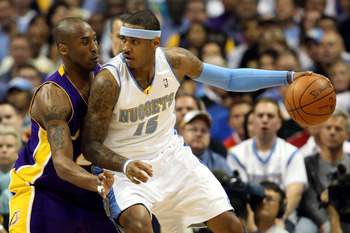
Best “Post” Perimeter Defender – Kobe Bryant, LA Lakers
Even great post-up scorers like Melo have a hard time scoring on Kobe
This one’s easy.  Kobe is a perennial All-NBA defender, even at this stage of his career.  When coaches design pick-and-roll plays, they tend not to design them even for their big guys to post up against Kobe.  Why?  He’s hard to score on for anybody, both perimeter and post players.  If you’re a guard that likes to post up (e.g. Andre Miller, Jason Kidd, Chauncey Billups), forget about posting Kobe up.  He’s very strong and can body up on almost anybody.  If you do want to post him up, you gotta be both stronger and taller than him.  Even then, he’ll make it tough on you. 

If you want proof, just go back and watch any playoff series they had with Phoenix.  D’Antoni tried running some pick-and-roll plays with Kobe switching on to Boris Diaw, and Diaw couldn’t make Kobe budge in the post.  Also, one of the major downfalls of the pre-Redeem Team Olympic squads was their defense against the pick-and roll.  Chris Paul, Allen Iverson, and other small guards were constantly abused by bigger defenders that they had to guard at times.  When Kobe joined the Redeem Team in 2008, opponents had no such luck in those situations.

Runner-ups for this category are New York’s Chauncey Billups and Miami’s LeBron James.

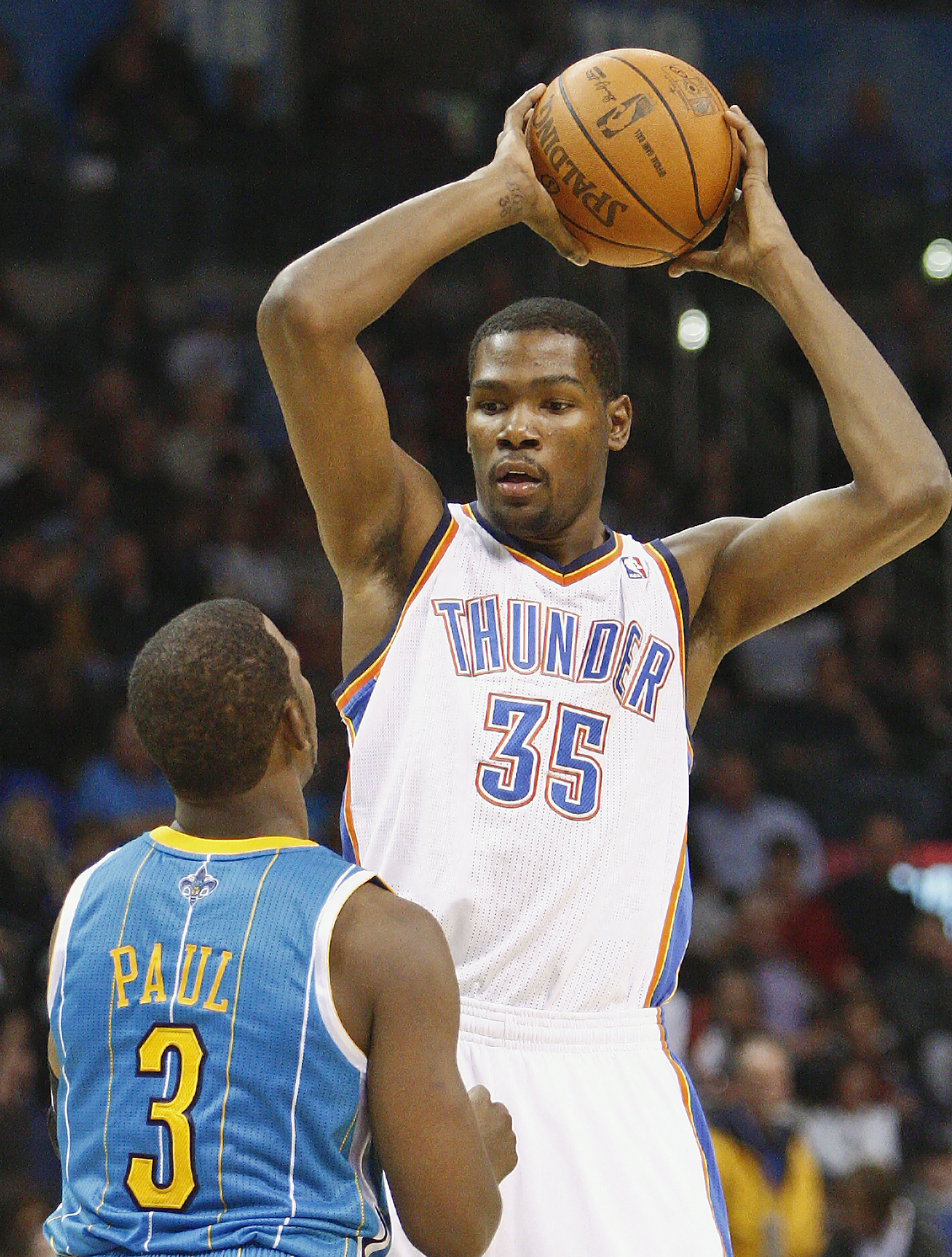
Best Help Defender on Perimeter –Chris Paul, New Orleans
Using his speed and quickness to his advantage, Paul gambles off of his man fairly often and makes very effective double teams on both post and perimeter players.  Whenever opponents face the Hornets, they always have their mind on Chris Paul, whether or not he is guarding them individually.  He is everywhere on the court, and every opponent is extra careful in both perimeter passes and entry passes to into the post.  Because he’s so good at this, he creates tons of fastbreak opportunities off steals by creating havoc in the passing lanes. 

Runner-ups for this category are Boston’s Rajon Rondo and Miami’s Dwyane Wade.

Best Help Defender in the Paint – LeBron James, Miami
I am giving LeBron this category almost solely because of his signature chase-down blocks on both fastbreak and half-court drives to the rim. This feat makes every player second-guess themselves on driving opportunities, even when they’re wide-open.  If LeBron’s nearby, it’s hard for anybody to make a layup without him chasing it down and swatting it emphatically into the backboard.

Runner-ups for this category are Miami’s Dwyane Wade and Portland’s Gerald Wallace.

Best Ball-Denying Perimeter Defender – Ron Artest, LA Lakers

Artest has aged and his ability to stay in front of defenders has declined a bit.  Still, no matter how many picks are set for an offensive player, Artest takes tremendous pride in staying on him and denying him the ball by being physical and using his quick hands.  By doing this, he deflects a lot of passes (as with the aforementioned stop vs. Kevin Durant) and frustrates scorers that try to get the ball.  He is also good with the dirty veteran tactics, such as holding players jerseys before they try running away from him.  To this day, very few players have had success against Artest.  

Runner-ups for this category are LA’s Derek Fisher and OKC’s Thabo Sefolosha.

Best Charge-Taking Perimeter Defender – Derek Fisher, LA Lakers
No longer very good at guarding quick point guards, Fisher still knows how to step in front of driving players and taking charges.  His flopping ability helps get him the calls, as well.  It's tough for a defender to draw charges, especially since referees tend to favor superstars on their drives to the rim.  But Fisher is able to deter their reputation by drawing those fouls very effectively, even when he doesn't have position.  By the way, Fisher is the third Laker on this list.  If you wondered why even the best perimeter players struggle against this team, that fact reflects the reason behind it.  

Runner-ups for this category are Memphis’ Shane Battier and Utah’s Raja Bell. 

Best “Kobe Stopper” – Tie:  Dwyane Wade, Miami AND Thabo Sefolosha, OKC
Sefolosha has great defensive one-on-one instincts
I know I’ve previously declared D-Wade as the best Kobe defender.  But after watching Sefolosha yesterday, he reminded me how great of a one-on-one defender he really is.  He NEVER falls for pump fakes, reading his opponents’ moves extremely well.  We saw Kobe burn him on this day in the end, but that was as tough a shot as he could have taken and Kobe still only ended up 8-22 from the field.  Jeff Van Gundy raves about what a world-class defender he really is - and Jeff knows good defense when he sees it.  With his defensive talents, Sefolosha is asked to guard every opposing team’s best perimeter defender, and he does an outstanding job at it.   We never hear of him because he is not much of a scorer, but he has relished the role of a defensive stopper.  For now, I’ll say he’s on par with D-Wade, who is no slouch himself.  Wade averages the most blocks per game of any guard, and those come from both his one-on-one and help defense. When he doesn't get the rejection, he does a great job of at least contesting every shot he can.
When the playoffs come around, these two guys will be guarding the best offensive players in the league in their respective conferences.

Runner-ups for this category are Detroit’s Tayshaun Prince and Memphis’ Shane Battier.

POST DEFENSE

Now, let’s give the big guys some of their own defensive categories:
1.       Best “Perimeter” Post Defender – the counterpart to the above category of perimeter players that guard post players – the post player most effective at guarding perimeter players, particularly after pick-and-roll switches.
2.       Best "Hedger" – the post player best at hedging, or trapping, perimeter players off pick-and-rolls and returning to the post.
3.       Best Weak-Side Shot Blocker – player most effective at coming from the weak side – off their man – to block post or perimeter players.
4.       Best Overall Anchor of the Paint – player who is the best at protecting the paint and intimidating any intruders, particularly when helping their teammates on the perimeter get beat on drives to the rim by opponents.
5.       Best One-on-One Post Defender – player who is the most effective at individual post defense. 

Best “Perimeter” Post Defender – Kevin Garnett, Boston Celtics
Garnett is arguably the league’s most versatile defender who can guard all 5 positions.  He has a deadly combination of length and quickness, and is the main reason why Boston became a defensive powerhouse when he arrived for the 2007-08 season.  KG combines his natural defensive abilities with his infamous verbal jousting playing normal one-on-one defense, but also uses it to intimidate perimeter players from coming his way.  Perimeter guys like Steve Nash feast on mismatches when a big switches to guard him on the perimeter, where he can blow by his bigger, slower opponent.  But if you’re a perimeter guy facing a big, long and scary dude who’s clapping in your face and stays in front of you, it’s intimidating.  Just watch this clip of him guarding Toronto point guard Jose Calderon.

Runner-ups for this category are Miami’s Chris Bosh and Atlanta’s Josh Smith.

Best "Hedger" – Chris Bosh, Miami
Say what you want about Bosh’s lower-than-expected contributions on the offensive end as the third fiddle behind D-Wade and LBJ.  On defense, he is one of the main reasons why Miami is a great defensive team.  Bosh is particularly good at trapping perimeter players on pick-and-rolls, and is very effective at cutting off passing lanes to cutting bigs. He was very effective at this during in the 2008 Olympic Gold-Medal Run.  Team USA had sorely lacked someone like Bosh in their losses from 2002-06, despite having several prominent bigs (e.g. Duncan, Lamar Odom, Carlos Boozer, etc).  Bosh isn't the greatest one-on-one post defender, given his small frame. But he sure makes up for it in many other defensive facets.

Runner-ups for this category are Cleveland’s Anderson Varejao and Boston’s Kevin Garnett.

Best Weak-Side Shot Blocker – Tyson Chandler, Dallas Mavericks
Tyson Chandler and Trevor Ariza - Dallas Mavericks v New Orleans Hornets
Chandler gives the Mavs some much-needed help D
Before this season, I would automatically gives this award to Josh Smith.  But Chandler has come into his own on the defensive end this year.  When healthy, Chandler is always among the NBA’s best post defenders.  He has proven to be a great asset to Dallas and a perfect complement to Dirk Nowitzki, whose defensive shortcomings were constantly exposed in recent playoff losses.  With a healthy Chandler helping Dirk from the weak side, Dallas should be a championship contender.

Runner-ups for this category are Portland’s Marcus Camby and Josh Smith, Atlanta.

Best Overall Anchor of the Paint – Dwight Howard, Orlando
A perennial Defensive Player of the Year contender, Dwight is always among the league leaders in blocks and rebounds.  This is solidified by his command of the paint on the defensive end.  If you’re a perimeter defender on the Magic, you have the luxury of Dwight protecting the paint against anybody who beats you off the dribble.  Therefore, it allows defenders to press up against players on the perimeter instead of backing off (i.e. they don’t have to fear their opponent blowing by them as much).  

Lately, however, Howard has publicly expressed frustration with teammates for abusing this luxury and not putting any effort in keeping perimeter players in front of them.  Howard is great at anchoring the paint, but even he can’t guard everybody.  A final straw for Magic GM Otis Smith to pull the trigger on trading away Vince Carter and Rashard Lewis was for this very reason – particularly against Denver, when Carmelo Anthony absolutely torched Orlando for 35 points on 14-21 shooting.  Now in Phoenix, Carter has been getting benched in favor of Mikael Pietrus, a much better defender who Orlando misses dearly.  Dwight is the one guy you can’t blame for players getting points in the paint, so instead people question Vince Carter and Rashard Lewis’ defensive deficiencies (and rightfully so). 

The Two-time defending Defensive Player of the Year is a beast on the low block

Overall, Dwight makes it intimidating for any opponent to drive to the paint.  NBA coaches’ offensive schemes generally are designed to avoid dealing with D12 in the paint area.

Runner-ups for this category are San Antonio’s Tim Duncan, Portland’s Marcus Camby and Boston’s Kevin Garnett.

There are certain players who are among the league’s elite in more than one category.  But this really shows that there are multiple ways to be effective on the defensive end.  There really aren’t any stats you can use to quantify these categories of skills.  But NBA coaching staffs do notice great defensive qualities, which is why you sometimes see offensive juggernauts benched in favor of better defenders when the game is on the line. Some great defenders aren't the flashiest or most exciting players, and thus are seldom talked about outside of their home fan base.  But take a look at the best defenders from the last three years - these guys do get recognition.


Sunday, January 30, 2011

NBA "Villains"


At this very moment, I’m watching the Celtics and Lakers – the NBA’s best rivalry - on ABC.  Since I really enjoy reading Bill Simmons’ live diary columns, where he compiles all his thoughts at certain points throughout a game, I was tempted to mimic such a column on this game.  Watching the heated matchups between players, any game between these two teams would make for a very entertaining diary - especially if you’re allowed to quote players uncensored.  Since I can’t lip-read everything on TV and not rich enough to sit close enough to hear players constantly berating each other, I’m not able to come up with such diaries.  Plus, the Sports Guy kind of does that, anyway.   I’ll hold off on stealing people’s ideas, especially people whose columns I actually like. 

Anyway, it’s easy to see how all the great matchups in this game (Bryant vs Pierce, Garnett vs. Gasol, Allen vs. Fisher) create tension between players.  For the fans, it’s fun to watch.  It also gives fans more incentive to root for their teams, especially when a player on the other team is giving your favorite player a hard time.  There are so many guys that fall into the “You-Either-Love-Him-Or-Hate-Him” category.  But overall, certain guys are hated a lot more than they’re loved.  They have become villains of the NBA. 

I decided to give a crack at ranking the villains of the league – those who are enemies in most eyes but also have completely embraced that role.  Most of these guys, unsurprisingly, are playing in this game.

5.  Paul Pierce/Kevin Garnett
Pierce and KG have been a formidable duo and are considered nightmare matchups for any opponent.  What really gets under the skin of their opponents (and fans) is that they’re not shy about rubbing it in their faces. 

Outside of Boston, there are mixed opinions on Pierce at best.  He is known for his smack talk to opponents, even in the middle of iso plays.  He relishes these opportunities, knocking down clutch shots on a routine basis.  But as all anti-Boston fans will remind you, there are other reasons for disliking him.  His pride, confidence and competitiveness often carry through to his demeanor off the court.  You can tell that it bleeds through things he says at press conferences.  Perhaps a lot of hate was generated toward him from Lakers fans during Game 1 of the 2008 NBA Finals, where Pierce appeared to hurt his knee.  About 30 seconds after being carried off the court, he magically recovered and destroyed the Lakers in that series, earning Finals MVP honors.  While some saw this as a “Willis Reed” moment, most questioned the injury and Pierce’s toughness as he was carried off the court.  Personally, I don’t think anybody should question the toughness of a guy who was stabbed 11 times and had a bottle smashed over his head, only to return to full health just days later.  After Game 1 of last year's first round match-up between Miami and Boston, Quentin Richardson bashed both Pierce and Garnett, calling them "actresses."   Either way, you either love the guy or hate him. 

Like them or not, Pierce and KG will talk a lot of trash - and back it up

As for KG, well, I have already mentioned previously that he is easily the NBA’s premier trash talker (btw – notice how many of SI’s top 10 trash talkers are on this list also).  Even Joakim Noah recently had to vent about him.  It seems like his popularity with other players and fans has declined somewhat –somewhat noted by not being voted as a starter to the All-Star game for the first time in ump-teen years.  As this is the latter phase of his outstanding career, he uses his savvy veteran tactics a lot more than sheer physical ability – including verbal jousting to get inside his opponents’ heads.  This particular season, he’s had numerous run-ins with many players (examples of late:  Dwight Howard, Channing Frye, and Mickael Pietrus) – and picking up technical fouls more often than he did earlier in his career. 

4.  Derek Fisher
From an opponent’s standpoint, is there a more irritating guy to play against?  Widely regarded as the best “flopper” of the NBA, he is easily leading the league in terms of how many times he’s tricked NBA officials.  And who can argue against the label of being a dirty player?  In the 2009 Western Conference Semifinals, Fisher took a complete cheap shot at Houston’s Luis Scola

Also, can you blame the entire state of Utah for absolutely loathing this guy?  In their eyes, he went from a loveable  figure (with the condition of his daughter during the 2007 playoffs, where he famously showed up late after taking his daughter to a doctor in New York for treatment drained a game-winning 3 pointer to help the Jazz K.O. Golden State) to a complete scoundrel.   Not just because he ditched the Jazz that offseason to join the Lakers, but also for the reason behind it:  he apparently thought that there were no doctors near Salt Lake City that were good enough to treat his daughter.  Huh?  Talk about adding salt to the wound.

The weirdest part about this is the fact that Fisher is the President of the NBA Players Association.  If you’re a player and you get in trouble with the league front office – be it a fine or suspension – D-Fish is the guy you need to stand by your side.  How weird must that be for guys that hate playing him (and vice versa)? That’s like asking your ex-girlfriend to put in a good word for you to your future wife’s parents.  Maybe he’s good at not holding grudges.  But I doubt it.

If Robert Horry were still playing, I think the two of them would be tied at this spot.   The fact that both of them can get inside their opponents’ heads and hit ridiculously clutch shots throughout their careers has given plenty of ammo for anti-Lakers fans to hate them.

3.  Bruce Bowen
I know, I know – he recently retired.  But he really deserves to be on this list.  Aside from many players who have publicly trashed Bowen in press conferences, how many of Bowen’s opponents have completely avoided any questions from the press regarding their opinions about him?  Probably about 100. Drawing criticism from both coaches and players (and famously dubbed the “Edward Scissorhands” nickname from Phil Jackson, citing Bowen’s physical-player grab-and-hold tactics), Bowen is both respected and hated for his ability to get under his opponents’ skin.  From Ray Allen to Steve Francis to Vince Carter to Steve Nash, Bowen has been constantly accused of playing dirty. 

Ray Allen, among many players, have expressed disdain over Bowen's play
Questions about Bowen’s defensive tactics came to light particularly after he puts his foot underneath players after they shoot –same manner in this video of him guarding New York Knicks guards Steve Francis and Jamal Crawford.  In fact, Isiah Thomas reportedly told his players to “break his ------- foot” if they saw Bowen do that to another player.  How does he get away with this?  I say it’s because of his super nice personality off the court.  I’m sure he’s very diplomatic with NBA officials and the league office whenever he’s asked about his defensive strategy.

Dirty or not, Spurs coach Greg Popovich has used Bowen masterfully, having covered top scorers like Dirk Nowitzki very effectively.  But effective or not, Bowen’s physical play did not make very many friends (or fans outside of San Antonio).  And he’s succeeded and won championships because of it.

2.  Kobe Bryant
Before this off-season, Kobe has been the clear-cut number 1 on this list for several years. 
Now before I break down all the things he’s done to solidify his villainy, I’ll say this:  his popularity has definitely recovered since the mind-boggling rape accusations (a tremendously HUGE blow to his image, regardless of whether or not he was at fault).  To his defense, Kobe has been in a no-win situation -both on and off the court.  In games, he is criticized whenever his team loses and he takes too many shots.  When he doesn’t shoot that much and the Lakers lose, he is criticized for not carrying the load.  When the Lakers lose and Kobe gets on his teammates, he is seen as a total a-hole. 

As much as Laker fans want to defend Kobe, it’s hard not to hold him accountable as to why he’s had so much more difficulty with keeping a good image than most superstars in the NBA.  Now I know this is irritating to both Kobe and Jordan fans (and me), but I’m going to compare Kobe to MJ’s golden standard:  Did Jordan get the same criticism for shooting too much (or too little)?  Maybe he did very early in his career, but he was winning championships left and right ever since.  Did MJ ever (publicly) demand a trade?  Absolutely not. 

Before I go on and on comparing Kobe to MJ, take a look at this must-read article:  an extremely solid case breaking down MJ vs. Kobe by Skip Bayless.  It will save me from spinning wheels trying to explain this. 
Why was Kobe so hated?  For one, he was widely regarded as a not-so-pleasant teammate.  Many sources blamed him for his rocky relationship with Shaq and breaking up the Shaq-Kobe duo.  In all fairness, Shaq was probably not the easiest teammate to play with – just ask Penny Hardaway.  But Kobe’s competitiveness often got the best of him in many interpersonal situations with teammates and coaches.  In his earlier days as a Laker, Kobe was widely regarded as a loner.  He has made more of an effort to be outgoing and social with his current teammates, but he clearly had problems getting along with people early on in his career.  Even coaches have publicly complained about him.  Phil Jackson famously described Kobe as “uncoachable” in his book.  Is he a good teammate?  This can be questionable as well.  If I’m Andrew Bynum, I don’t think I could stand playing with him.  He was infamously caught on tape bashing Mitch Kupchak’s decision to refuse trading Bynum for Jason Kidd.  Remember when he accidentally injured Andrew Bynum in the middle of the 2008-09 season?  Pay close attention to his initial reaction.  It really seemed as though he was feeling more upset about possibly missing out on a title than he was genuinely concerned for his teammate.

Shaq and Kobe couldn't put their egos aside, and Shaq moved elsewhere

We all know Kobe wants to win more than anybody.  But how is his attitude when his team faces adversity?  Kobe has had several games where he quit on his team.  I don’t know how you can spin it any other way.  The two such episodes that come to mind are Game 7 vs. Phoenix in 2006 and Game 6 vs. Boston in 2008.  In that game vs. Phoenix, Kobe took one shot attempt during the entire 2nd half.  Even Charles Barkley called him out, saying Kobe was trying to prove a point and flat out quit on his team.    Even during his offensive “explosions” of scoring 60+ points, some of his teammates were reportedly not particularly pleased.  Trevor Ariza got an unfriendly glare from Kobe after not giving him the ball on a possession during a 61 point, 0 rebound, and 3 assist effort vs. the Knicks.  A 61/0/3 stat line is quite the individual accomplishment, but hardly indicative of any teamwork whatsoever.  

On top of the turmoil with his own teammates and coaches, he doesn’t exactly get along very well with his peers on other teams, either.  Ray Allen publicly criticized Kobe for his request to be traded, basically saying that Kobe did not “get it” yet.  Raja Bell, Ron Artest, and Matt Barnes have all had heated (but hilarious) run-ins with Kobe.  A very physical player, Kobe is not shy about getting physical with his opponents.  Bell clotheslined Kobe in the aforementioned 2006 playoff series, and bashed him afterwards – calling him a “pompous, arrogant individual.”   Artest and Barnes expressed dislike for Kobe also, but I have no idea why they completely sold themselves out by joining Kobe in LA. 

One of these days, I will write an entry on how fortunate the Lakers have been to win all titles that they did during the past decade.  But I’ll address one of these reasons right now: if Pau Gasol doesn’t get gift-wrapped to LA (which, by the way, was the shadiest transaction in the history of the league – as the Lakers did not even have to trade their 10th best player back to Memphis), does Kobe really “change” into a better teammate, the way he is now? Does he ever win a title in his career again?  I have my doubts.  For all we know, he would have been traded to another team (in all likelihood, Chicago – but thank goodness that didn’t happen; the MJ comparisons would never have ended). 

If you think I’m a Kobe hater, read this article by Bill Simmons before you judge.  He lays out everything I touched on in a very comprehensive and unbiased manner.  I will say this:  despite his reputation as a villain and being criticized often by fans, coaches, and players alike, Kobe has obviously had great success in his career.  He is immensely gifted and has a terrific work ethic.  His desire to win is unsurpassed by many, and he has 5 championship rings to show for it.  He may not be the most popular superstar of all time, but he may end up being one of the most successful ones.  You just gotta wonder if he would have had more success if you took away some of the self-inflicted drama he’s had in his career.    

1.  Lebron James
This is a no-brainer.  Remarkably, he probably wouldn’t have even been on this list prior to ‘The Decision.’  But at this very moment, he is THE most hated player – perhaps in all of sports.  I’ve seen approximately 20 videos mocking his Nike commercial, where he tries to defend the manner in which he handled his decision to leave Cleveland.  Everybody on this list has plenty of ill-wishers, but I’ve never seen it get to this level.  Has anyone been rooted this hard to fail to the point where voodoo dolls and witchcraft are summoned

Just like these LBJ jerseys, Lebron's popularity burned. Big time.

Honestly, I’m surprised he wasn’t more unpopular prior to free agency.  Everyone pays a lot more attention NOW to his poor choice of words in several press conferences.  But it’s not like he got worse – he’s never been known for being very articulate or making any sense.  Also, how about his constant teasing of the fans when it comes to entering the Dunk Contest?  If he truly cared about the fans, he would dunk.  Period.  MJ, Dominique, Kobe, Vince, Dwight – they all did it out of respect for the fans, whether they wanted to do it or not.  One of his excuses is that he doesn’t want people to think of him “as just a dunker.”  Well, that would be better than being thought of as a complete d-bag by 49 and ½ states, wouldn’t it? 

(On a side note, I can’t WAIT to see Blake Griffin in this year’s Dunk Contest.  He will be incredible.)

All of these guys have completely embraced their villain role, at the expense of their popularity with a majority of the world.  They are all motivated by the intense hatred towards them.  With so many people rooting for them to fail, these guys are wired in a way where they all feast off that criticism and ill wishing.