You could describe yesterday’s Thunder-Lakers and Heat-Knicks games with one word: defense. Despite all four of those teams being known for their offensive firepower, these games were really about a terrific display of defense. As any coach will tell you, close games come down to defensive stops. In the case of these two games, the Lakers and Knicks were able to come up with stops, and the Thunder and Heat were not.
In the final possessions of the Thunder-Lakers game, LA made three crucial defensive stops: Gasol took a charge on Westbrook’s drive, Ron Artest deflected a pass intended for Kevin Durant that led to a steal, and of course LA contested the desperation 3’s in the last five seconds by KD and James Harden to perfection. On the other end, OKC’s Thabo Sefolosha played tremendous defense (as usual) on Kobe all night, but was unable to stop Kobe’s dagger fade-away in the closing minutes.
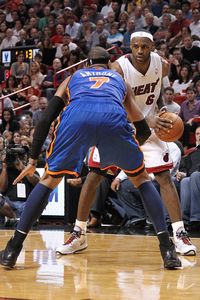
In the Heat-Knicks game, LeBron James was seemingly scoring at will against the Knicks defense. But in the closing minutes, he failed to convert on a driving layup – thanks to Amare Stoudemire making a great block coming from the weak side (yes, I complimented Amare’s defense – but he deserves credit for this one time) – and he missed a potential game-tying three pointer in the closing seconds thanks to Carmelo Anthony’s contest (and LeBron’s inability to hit clutch jump shots, as I’ve pointed out earlier). On the other end, Chauncey Billups
made some clutch plays, including draining a serious long-ball from about 33 feet after catching D-Wade off guard - tricking him by picking up his dribble and looking to pass to a teammate. I bet Knicks fans don’t miss Raymond Felton anymore after the last few games since the trade.
 |
| Melo was locked in defensively vs. LeBron |
Great offense beats great defense, but that is what makes making defensive stops that much more challenging. As Charles Barkley says, there are two sides of the court, and you need to judge teams and players at both of those ends. If there was only one side of the court, the Mike D’Antoni era of the Phoenix Suns would have been a dynasty. But that’s what leads to the saying of the cliché that everybody in the basketball world has come to learn: Defense Wins Championships.
There are several ways a player can help his team on the defensive end of the court. Perimeter players can play great one-on-one defense and contest shots as best they can. They can also be active on the passing lanes and create easy offense and transition plays. Big guys can either play great post defense one-on-one, or they can anchor the paint and help on opponents that drive to the rim. All of these examples of contributions are critical to team success. In other words, there’s a reason why guys like Sefolosha, Anderson Varejao, Ben Wallace and Jason Collins are in the NBA; they all are extremely skilled defensive players and are very valuable to any team, despite their limited offensive abilities. Since there are so many different types of effective defense, it doesn’t make sense to crown one person as the league’s best overall defender. Instead, you look at several categories and aspects and see who excels in those areas. Keeping this in mind, I will break down the league’s best defenders in some of the major areas for both perimeter and post players.
First, let’s go through categories of perimeter defense..
PERIMETER DEFENSE
1. Most Pesky Perimeter Defender – also known as the best “Edward Scissorhands” (aka the Bruce Bowen award) player who uses quick and disrupting hands the most effectively when guarding the NBA’s prolific perimeter scorers.
2. Best “Post” Perimeter Defender – the perimeter player who is the toughest to score on in the post. This category includes defending bigger guards, and guarding bigs when caught defending them on a pick-and-roll switches.
3. Best Help Defender on Perimeter – player most effective with pursuing double teams on the perimeter and helps off their man to create turnovers in the passing lanes.
4. Best Help Defender in the Paint – perimeter player who most effectively helps off their man to protect the paint against players making driving or post-up moves
5. Best Ball-Denying Perimeter Defender – player who makes it the most difficult for players they guard that try to free themselves to get the ball.
6. Best Charge-Taking Perimeter Defender – perimeter player who is the best at taking charges versus driving players.
7. Best “Kobe Stopper” – player who guards unstoppable perimeter scorers the most effectively one-on-one without help.
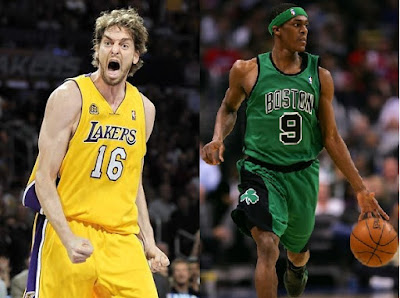
Most Pesky Perimeter Defender (the Bruce Bowen Category) – Rajon Rondo, Boston
Rondo is a real pest against players with the ball. When he guards you, you better make sure you have a tight grip on the ball. Always among the league leaders in steals, Rondo uses his hands to take swipes at the ball and also is good at waving his hands around to deter the vision of players he’s guarding. Pesky play is very effective at getting under the skin of great scorers. It’s the reason why Doc put him LeBron during their last game in Boston. It was very difficult for LeBron to facilitate the offense and get in a rhythm with Rondo playing him that way.
Runner-ups for this category are LA's Derek Fisher and San Antonio's Manu Ginobili.
Best “Post” Perimeter Defender – Kobe Bryant, LA Lakers
 |
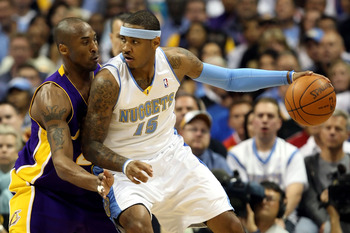
| Even great post-up scorers like Melo have a hard time scoring on Kobe |
This one’s easy. Kobe is a perennial All-NBA defender, even at this stage of his career. When coaches design pick-and-roll plays, they tend not to design them even for their big guys to post up against Kobe. Why? He’s hard to score on for anybody, both perimeter and post players. If you’re a guard that likes to post up (e.g. Andre Miller, Jason Kidd, Chauncey Billups), forget about posting Kobe up. He’s very strong and can body up on almost anybody. If you do want to post him up, you gotta be both stronger and taller than him. Even then, he’ll make it tough on you.
If you want proof, just go back and watch any playoff series they had with Phoenix. D’Antoni tried running some pick-and-roll plays with Kobe switching on to Boris Diaw, and Diaw couldn’t make Kobe budge in the post. Also, one of the major downfalls of the pre-Redeem Team Olympic squads was their defense against the pick-and roll. Chris Paul, Allen Iverson, and other small guards were constantly abused by bigger defenders that they had to guard at times. When Kobe joined the Redeem Team in 2008, opponents had no such luck in those situations.
Runner-ups for this category are New York’s Chauncey Billups and Miami’s LeBron James.
Best Help Defender on Perimeter –Chris Paul, New Orleans
Using his speed and quickness to his advantage, Paul gambles off of his man fairly often and makes very effective double teams on both post and perimeter players. Whenever opponents face the Hornets, they always have their mind on Chris Paul, whether or not he is guarding them individually. He is everywhere on the court, and every opponent is extra careful in both perimeter passes and entry passes to into the post. Because he’s so good at this, he creates tons of fastbreak opportunities off steals by creating havoc in the passing lanes.
Runner-ups for this category are Boston’s Rajon Rondo and Miami’s Dwyane Wade.
Best Help Defender in the Paint – LeBron James, Miami
I am giving LeBron this category almost solely because of his
signature chase-down blocks on both fastbreak and half-court drives to the rim. This feat makes every player second-guess themselves on driving opportunities, even when they’re wide-open. If LeBron’s nearby, it’s hard for anybody to make a layup without him chasing it down and swatting it emphatically into the backboard.
Runner-ups for this category are Miami’s Dwyane Wade and Portland’s Gerald Wallace.
Best Ball-Denying Perimeter Defender – Ron Artest, LA Lakers
Artest has aged and his ability to stay in front of defenders has declined a bit. Still, no matter how many picks are set for an offensive player, Artest takes tremendous pride in staying on him and denying him the ball by being physical and using his quick hands. By doing this, he deflects a lot of passes (as with the aforementioned stop vs. Kevin Durant) and frustrates scorers that try to get the ball. He is also good with the dirty veteran tactics, such as holding players jerseys before they try running away from him. To this day, very few players have had success against Artest.
Runner-ups for this category are LA’s Derek Fisher and OKC’s Thabo Sefolosha.
Best Charge-Taking Perimeter Defender – Derek Fisher, LA Lakers
No longer very good at guarding quick point guards, Fisher still knows how to step in front of driving players and taking charges. His flopping ability helps get him the calls, as well. It's tough for a defender to draw charges, especially since referees tend to favor superstars on their drives to the rim. But Fisher is able to deter their reputation by drawing those fouls very effectively, even when he doesn't have position. By the way, Fisher is the third Laker on this list. If you wondered why even the best perimeter players struggle against this team, that fact reflects the reason behind it.
Runner-ups for this category are Memphis’ Shane Battier and Utah’s Raja Bell.
Best “Kobe Stopper” – Tie: Dwyane Wade, Miami AND Thabo Sefolosha, OKC
 |
| Sefolosha has great defensive one-on-one instincts |
I know I’ve previously declared D-Wade as the best Kobe defender. But after watching Sefolosha yesterday, he reminded me how great of a one-on-one defender he really is. He NEVER falls for pump fakes, reading his opponents’ moves extremely well. We saw Kobe burn him on this day in the end, but that was as tough a shot as he could have taken and Kobe still only ended up 8-22 from the field. Jeff Van Gundy raves about what a world-class defender he really is - and Jeff knows good defense when he sees it. With his defensive talents, Sefolosha is asked to guard every opposing team’s best perimeter defender, and he does an outstanding job at it. We never hear of him because he is not much of a scorer, but he has relished the role of a defensive stopper. For now, I’ll say he’s on par with D-Wade, who is no slouch himself. Wade averages the most blocks per game of any guard, and those come from both his one-on-one and help defense. When he doesn't get the rejection, he does a great job of at least contesting every shot he can.
When the playoffs come around, these two guys will be guarding the best offensive players in the league in their respective conferences.
Runner-ups for this category are Detroit’s Tayshaun Prince and Memphis’ Shane Battier.
POST DEFENSE
Now, let’s give the big guys some of their own defensive categories:
1. Best “Perimeter” Post Defender – the counterpart to the above category of perimeter players that guard post players – the post player most effective at guarding perimeter players, particularly after pick-and-roll switches.
2. Best "Hedger" – the post player best at hedging, or trapping, perimeter players off pick-and-rolls and returning to the post.
3. Best Weak-Side Shot Blocker – player most effective at coming from the weak side – off their man – to block post or perimeter players.
4. Best Overall Anchor of the Paint – player who is the best at protecting the paint and intimidating any intruders, particularly when helping their teammates on the perimeter get beat on drives to the rim by opponents.
5. Best One-on-One Post Defender – player who is the most effective at individual post defense.
Best “Perimeter” Post Defender – Kevin Garnett, Boston Celtics
Garnett is arguably the league’s most versatile defender who can guard all 5 positions. He has a deadly combination of length and quickness, and is the main reason why Boston became a defensive powerhouse when he arrived for the 2007-08 season. KG combines his natural defensive abilities with his infamous verbal jousting playing normal one-on-one defense, but also uses it to intimidate perimeter players from coming his way. Perimeter guys like Steve Nash feast on mismatches when a big switches to guard him on the perimeter, where he can blow by his bigger, slower opponent. But if you’re a perimeter guy facing a big, long and scary dude who’s clapping in your face and stays in front of you, it’s intimidating. Just watch this clip of him
guarding Toronto point guard Jose Calderon.
Runner-ups for this category are Miami’s Chris Bosh and Atlanta’s Josh Smith.
Best "Hedger" – Chris Bosh, Miami
Say what you want about Bosh’s lower-than-expected contributions on the offensive end as the third fiddle behind D-Wade and LBJ. On defense, he is one of the main reasons why Miami is a great defensive team. Bosh is particularly good at trapping perimeter players on pick-and-rolls, and is very effective at cutting off passing lanes to cutting bigs. He was very effective at this during in the 2008 Olympic Gold-Medal Run. Team USA had sorely lacked someone like Bosh in their losses from 2002-06, despite having several prominent bigs (e.g. Duncan, Lamar Odom, Carlos Boozer, etc). Bosh isn't the greatest one-on-one post defender, given his small frame. But he sure makes up for it in many other defensive facets.
Runner-ups for this category are Cleveland’s Anderson Varejao and Boston’s Kevin Garnett.
Best Weak-Side Shot Blocker – Tyson Chandler, Dallas Mavericks
 |
| Chandler gives the Mavs some much-needed help D |
Before this season, I would automatically gives this award to Josh Smith. But Chandler has come into his own on the defensive end this year. When healthy, Chandler is always among the NBA’s best post defenders. He has proven to be a great asset to Dallas and a perfect complement to Dirk Nowitzki, whose defensive shortcomings were constantly exposed in recent playoff losses. With a healthy Chandler helping Dirk from the weak side, Dallas should be a championship contender.
Runner-ups for this category are Portland’s Marcus Camby and Josh Smith, Atlanta.
Best Overall Anchor of the Paint – Dwight Howard, Orlando
A perennial Defensive Player of the Year contender, Dwight is always among the league leaders in blocks and rebounds. This is solidified by his command of the paint on the defensive end. If you’re a perimeter defender on the Magic, you have the luxury of Dwight protecting the paint against anybody who beats you off the dribble. Therefore, it allows defenders to press up against players on the perimeter instead of backing off (i.e. they don’t have to fear their opponent blowing by them as much).
Lately, however, Howard has
publicly expressed frustration with teammates for abusing this luxury and not putting any effort in keeping perimeter players in front of them. Howard is great at anchoring the paint, but even he can’t guard everybody. A final straw for Magic GM Otis Smith to pull the trigger on trading away Vince Carter and Rashard Lewis was for this very reason – particularly against Denver, when Carmelo Anthony absolutely torched Orlando for 35 points on 14-21 shooting. Now in Phoenix, Carter has been getting benched in favor of Mikael Pietrus, a much better defender who Orlando misses dearly. Dwight is the one guy you can’t blame for players getting points in the paint, so instead people question Vince Carter and Rashard Lewis’ defensive deficiencies (and rightfully so).
 |
| The Two-time defending Defensive Player of the Year is a beast on the low block |
Overall, Dwight makes it intimidating for any opponent to drive to the paint. NBA coaches’ offensive schemes generally are designed to avoid dealing with D12 in the paint area.
Runner-ups for this category are San Antonio’s Tim Duncan, Portland’s Marcus Camby and Boston’s Kevin Garnett.
There are certain players who are among the league’s elite in more than one category. But this really shows that there are multiple ways to be effective on the defensive end. There really aren’t any stats you can use to quantify these categories of skills. But NBA coaching staffs do notice great defensive qualities, which is why you sometimes see offensive juggernauts benched in favor of better defenders when the game is on the line. Some great defenders aren't the flashiest or most exciting players, and thus are seldom talked about outside of their home fan base. But take a look at the best defenders from the last three years - these guys do get recognition.