As the first weekend of March Madness comes to a close, I thought this would be an appropriate topic. A few years ago, Skip Bayless wrote this very comprehensive article on why he prefers the NBA over college. Granted he was wrong about the star potential of a few elite college players (e.g. Chris Paul, Deron Williams). Still, he’s still dead on in the sense that the format, rules, and superior players make the NBA much more appealing. Give that a quick read before reading the rest of my post.
Now, all the reasons Skip listed are among the many as to why I can’t get into college basketball. Basketball is by far my favorite sport, and I still have trouble watching college games. Unless you’re a die-hard fan of a particular team, I just can’t see why people are so into it. I’ve heard many common arguments in favor of college basketball that I will cover below.
First, let’s cover the differences that even college fanatics and NBA enthusiasts, like me, will agree on:
FACT: Many great college players do not evolve into great professional players.
I just can’t help but remember but go back to the 2006 NBA Draft: Dick Vitale was getting over-the-top excited over Player of the Year contenders Adam Morrison and JJ Redick becoming lottery draft picks (Morrison at 3rd to the Bobcats, Redick at 11th to the Magic). Vitale went on and on about why great college players will make great NBA players, and that they deserve getting drafted early. Of course you know the rest: despite illustrious college careers, both Morrison and Redick turned out to be average players at best. Redick has somewhat turned his career around, becoming a regular in Stan Van Gundy’s lineup rotation. Sadly, the immense fall from grace has been a reality for most young star athletes going to the pros.
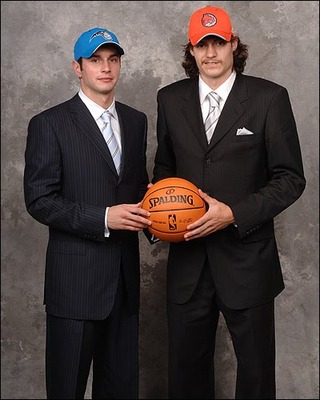 |
| More often than not, successful college players struggle in the NBA |
Think about that, though. Some college basketball fans I’ve talked to have told me that they enjoy seeing less gifted players being able to have a big impact on a game. Really?! Is that why college ball is more appealing to some people? Because guys with less talent have a better chance to be great in college? Is it inspiring? I don’t get it. Whether you're talking about Redick, Morrison, or Christian Laettner, college success does not always translate to the big leagues.
FACT: College fans are better
This is the one advantage of college teams I have to concede: college fans are far better – more enthusiastic, more genuine, and more supportive of their teams. In the eyes of many, this adds to the overall “excitement” of college basketball. But for me, this should be completely independent of the game itself. In the end, does the involvement of the crowd make me like the college game more? Of course not. Plus, I find it a whole lot easier to root for a team that plays for your school rather than your hometown.
Everyone in agreement so far? Let’s go over some of the common myths of college basketball:
MYTH: College basketball is more exciting than NBA basketball.
FACT: College basketball games are mired by poor decision making and all-around awful execution.
This is my main beef against college hoops: the level of play. Now obviously, professionals are better players than amateurs; that’s not the basis of my argument. The college game’s nature of poor decision making, questionable shot selection, and lack of poise down the stretch of games allow for many close games. But does this really help the quality of college basketball? College basketball games, much more so than NBA games, seem to come down to crucial mistakes as opposed to brilliant play-making.
There are so many examples to support this that I don’t even know where to start. Let’s take this year’s opening weekend of March Madness, for example. One of the most “exciting” games so far was Butler’s upset win over No. 1 seed Pittsburgh. Take a look at the end of this game. Every March Madness enthusiast raved about the excitement of this game. Not unlike many close games, this really came down to one mind-numbing, knuckle-headed play after another. Missing crucial free-throws, blowing big leads, committing horrendous fouls, taking bad shots – NBA coaches would have multiple heart attacks coaching these guys.
Missing crucial free throws seems to be a common theme in basketball, but MUCH more prevalent in the college game. It almost seems like there’s an unwritten rule mandating players to miss free throws in any close game. Some college fans find that this phenomenon adds to the excitement and unpredictability of the game, but that’s one of the many wrong reasons to like college ball. I’d love to get a hold of stats that show free throw percentages of college players in the last 2 minutes of games versus that of NBA players. Part of it is inexperience in intense situations. Also in college, the one-and-one penalty situation puts a lot more pressure on players to make their free throws, as one missed free throw essentially becomes a turnover. But I enjoy seeing players with poise that can ice games by knocking down crucial free throws.
 |
| College players hustle, but many seldom exhibit court smarts |
NCAA enthusiasts rave about the plethora of come-from-behind efforts by many teams. But consider how many times you see that happen in college hoops. I’ll give you one more example: in the ACC tournament, Miami blew a 19 point second-half lead against the UNC Tar Heels. But it wasn’t because of any brilliant playmaking by UNC; if you watch the highlights, in addition to missing free throws, Miami basically threw the ball away on multiple possessions in a row. They also committed several head-scratching fouls. Complete collapses like this never happen in the NBA. It’s far from fun to watch, because it just gets to a point where you wish teams wouldn’t beat themselves so often.
The truth is, the college game is very error prone, driven by players with poor decision making skills and shot selection. Of course, this allows for many close finishes to games. But again – all for the wrong reasons. You can almost never count on college teams to make good decisions down the stretch.
MYTH: March Madness is so much more exciting than the NBA Playoffs
FACT: The tournament has a very unpredictable opening – yes – but it’s usually anticlimactic.
This is the most common misconception. The format of the NCAA Tournament, in my opinion, really hurts college basketball. In the NBA, the best teams always square off – more often than not. As Charles Barkley says – in a 7-game playoff series, the better team always wins. I would say that’s true about 99% of the time, which is obviously a lot more often than you can say about the later rounds of the NCAA tournament. There’s less flukes, obviously, but I would personally much rather have better teams face each other when the stakes are high. Many complain about the lack of upsets in the NBA Playoffs, with dominant teams like the Bulls, Lakers, and Spurs always winning. But in NBA Playoff basketball, it’s a guarantee to see fantastic matchups and rivalries unfold. You're guaranteed to see a Laker-Spurs, Celtics-Bulls, Celtics-Heat, or any matchup between elite teams. In the NCAA, not so much. You can have a 'Cinderella' team like George Mason make the Final 4 (2006), only to get overwhelmed by a superior team and the tournament results in having anticlimactic final rounds.
 |
| In the NBA, there's a much better chance for the top teams to match up in the final rounds |
As welcoming as it is to welcome 65 teams in the tournament, this is a poor method to weed out the weaker teams of the NCAA and have the strongest teams go head-to-head. As a result of the current 65-team format, college games obviously tend to have many David-and-Goliath matchups that can be particularly appealing to some folks. Because it’s a one-and-done format, any team can beat anybody on any given day. This makes the first weekend of the tournament particularly exciting, as there is one nail-biter after another. But would you rather have great opening rounds, or better finishing ones? Would you rather see the Dukes, UNCs, Kentuckys, and Kansases of the NCAA square off in the later rounds of the Big Dance? Or would you rather see a ‘Cinderella Story’ team make the Final 4? I prefer the former.
 |
| While upsets are rare in the NBA, they are much more meaningful when they happen. |
In the NBA, upsets DO happen. And because it’s so much tougher to make it happen, that makes upsets way more meaningful. Remember in 2007, when the 8th seeded Golden State Warriors took down the Dallas Mavericks – the league’s best team at the time? That was much more spectacular than any upset in NCAA history, simply because of the incredibly difficult feat of defeating a Goliath team 4 times in 7 games.
The NBA does it right: weed out the pretenders early on to set up heavy-weight slugfests going at it for the title. The anti-climactic nature of the NCAA tournament sets everyone up for early gratification, but disappointing endings. The NCAA tournament gives more hope to the underdogs, but do you really want to see underdogs get lucky against a top team only to get blown out by superior teams in later rounds?
MYTH: College players have more heart than money-hungry professional players.
FACT: Both leagues have its share of hypocritical players and those who genuinely care.
 |
| With so many sports programs like Jim Tressel's Ohio State football team under investigation, is the NBA really that corrupt in comparison? |
Hypocrisy will corrupt anybody’s joy and enthusiasm for any sport; just look at the MLB and its ongoing steroid controversies. Yes, hypocrisy exists in all forms of every organized sport. But in the NCAA’s case, it seems that part of the recruiting routine of every high-profile program involves “illegal” bribery. It’s all a domino effect: it starts from doing whatever it takes to get great talent, and from there, future great players will want to go to your school. Given that recruiting comes out of a school’s budget, many bigger schools have a distinct advantage – which is why the Dukes, UNCs, etc. always seem to recruit the best players. When great players go to big schools, it inspires future great players to go to those schools. In turn, school reputation becomes a huge factor for every young prospect deciding where to go to school. The reality is that most big programs use every shady, dirty tactic in the book to land superstars.
 |
| When it comes to recruiting, teams try to do whatever it takes to get the nation's top players like C-Webb |
As for those who support the “genuine-ness” of college basketball, I’m afraid that’s very deceiving. Even if you ignore all the scandals out there, college players essentially DO get paid for their services. In a country where the cost of education is rising exponentially, you cannot understate how valuable college scholarships are. Add that to whatever gifts and preferential treatment they get from all the shady scandals on top of the free ride, and you get players who are almost as spoiled as the millionaire professional athletes.
I’m not necessarily saying that college athletes have no heart. In reality, you can’t really blame the kids for falling for bribes; if you’re a high school kid from an impoverished family, you don’t know any better – you’ll do whatever it takes, in turn, to look out for yourself and your family. As much as Derrick Rose, Chris Webber, and many others get criticized for unfair advantages they may have had, you can’t really blame 17-18 year old kids for looking out for their own well-being and being tricked by team officials. They don’t know any better. The blame should be placed on those offering the bribes: athletic directors, coaches, and everybody on the college athletic programs. Since that’s part of the reality of college sports, the college game is anything but genuine compared to the NBA. Is there corruption in the NBA? Of course there is. But the NCAA may be even more accountable.
In fairness to the players, they don’t make a fair share of what the NCAA profits from. The NCAA makes untold boat loads of money, and don’t give enough to its players. The fact that the NCAA can profit off of the players, and not give them a fair share, adds to the hypocrisy of college basketball. The NBA is a player's league, while the NCAA is a school for profit-seeking schools and power-hungry coaches.
MYTH: The rules of college basketball allow for a more exciting game than the NBA.
FACT: The rules of college basketball slow the game down drastically.
The watch-ability of college basketball is greatly hindered by many of its own rules and omissions. Here are some of the main rules in NCAA hoops that should be changed that, in turn, would improve the game:
1) The 35-second shot clock
This is the single most perplexing rule I think the college game has. 35 seconds is so long that you hardly ever see college teams strategize or utilize the clock properly. The shot clock becomes a non-factor in that sense, leading to many low-scoring games. You end up seeing teams waste their time running tons of offensive sets from well beyond the 3-point line – especially with teams without any dominant creators or post-up scorers (most of the country). In the NBA, teams only have 24 seconds to shoot, and only 8 of those 24 seconds to get the ball across the half court. In turn, that forces teams to push the pace and run their offensive sets quickly. With a 35-second shot clock, the college game suffers and the pace gets much, much slower. Hell, even the WNBA changed their shot clock from 30 to 24 seconds to make their game a bit more exciting.
2) Five Fouls to DQ/Two-halves game format
Many have uttered that college players should be allowed to commit 6 fouls before fouling out of a game. The combination of both having only 5 fouls to give and the NCAA format really hurts the game. The college game is 40 minutes compared to the NBA’s 48. But instead of 4 10-minute quarters, the NCAA opted to play two 20-minute halves. This directly results in the main impediment that NCAA bigs have – not being able to stay in the game. Often in games do the big guys commit two early fouls. As a result, they’re forced to sit out the entire first half. This really changes the complexion of the game and takes away from the impact that bigs have in these tournament games. Most college big men, as a result, can’t be very aggressive early in games.
3) Inability to advance the ball to half-court after a timeout (in the final minutes of a game)
Last year, when Butler had a chance to beat heavily favored Duke for the NCAA title, imagine what they could have drawn up if they didn’t have to get the ball up the court. Gordon Hayward nearly drained a half-court shot, but what if he didn’t have shave off precious seconds off the clock to scramble up court? We’ll never know. Being able to advance the ball to half court late in games adds another dimension that would make for many more great finishes. On offense, it really brings out creativity for a coach to draw up a last-second play in their own front-court. As a defending team, you’re forced to strategize on the defensive end and EARN a stop, as opposed to watching someone try to get the ball up court and miss a desperation ½-court or ¾-court shot. It’s much more rewarding for both sides. Advancing the ball after timeouts in late-game situation really adds another element to the greatness of NBA basketball. Because college basketball doesn’t mimic this, the game suffers.
 |
| Being allowed to advance the ball to half court allows for great plays to happen - like Derek Fisher's .4 second miracle shot |
4) The possession arrow
In the event of a jump-ball, the team with the possession arrow gets the ball. Seriously? Why not just do an actual jump-ball? Take luck and chance out of the equation if you want to make the game better. Make these 50/50 plays come down to hustle and determination – not a <bleep>ing arrow!
College basketball is fun to watch – but for all of the wrong reasons. If you can overlook all of college basketball’s shortcomings, then it’s definitely a joy to watch. I prefer the NBA, where the level of play is much better.

